|
|
 |
Click on your favorite client story below and tell others
about microfinance.
|
|
Entrepreneur
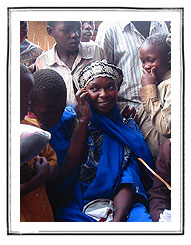
story #1: Fatima Serwoni, Uganda
A Local Call to Success
Fatima Serwoni lives in the village of Namunsi
in Uganda and runs a small store, selling food and
household items. She has built her business with
the help of a series of loans from FOCCAS, a local
microfinance institution. Since becoming a client,
she has increased her weekly income by 80 per cent
and has consistently paid the school fees for her
four children. With her most recent loan, Fatima
purchased a mobile phone kit to start a pay phone
business, becoming one of the first “village
phone operators” of MTN villagePhone, an initiative
of Grameen Foundation USA and MTN Uganda. Undeterred
that her village has no electricity, Fatima uses
a car battery to charge her phone. With the nearest
public pay phone more than four kilometres away,
people in Fatima’s community are happy to have
convenient and affordable telephone access for the
first time. Fatima is pleased with her new business,
which has the added benefit of attracting people
to her store and generating greater profit to share
with her family. |
| |
|
|
|
Entrepreneur
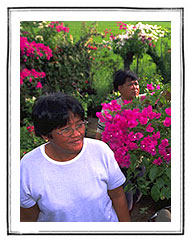
story #2: Gloria Caramat and Beth Sabinian, Philippines
A Blooming Business
Gloria Caramat and Beth
Sabinian started a floral landscaping business
in the Philippines in 1990. With a small business
loan from the Center for Agriculture and Rural Development
(CARD), Gloria and Beth expanded their business.
They now have two properties where their flowers—as
well as their business—are blooming. They sell
primarily to landscapers and real estate developers.
Gloria and Beth are now considering taking a larger
loan to help pay for a jeep, which they will use
to bring their flowers to new customers. This, they
hope, will reduce delivery costs. |
| |
|
|
|
Entrepreneur
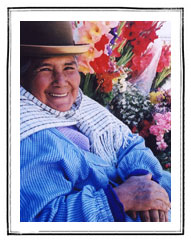
story # 3 Fortunata Maria de Aliaga, Bolivia
Three Children Finishing School
(Photo credit: Rohanna Mertens
for ACCION International)
Fortunata Maria de Aliaga has sold
flowers from a La Paz, Bolivia, street corner for
as long as anyone can remember. When her children
were young, she worked long days to give them the
opportunity she never had—the chance to go
to school. There were days when she barely had enough
money to set up shop.
Then, 15 years ago, Fortunata learned about Banco
Sol, a bank affiliated with ACCION International.
Together with three other women, she qualified
for a loan that allowed her to buy flowers in
bulk at a much cheaper rate. With a strong repayment
record, Fortunata was approved for larger loans
and began to borrow on her own. Today, Fortunata
is proud to report that she put her savings to
good use. “All three of my children finished
school,” she beams. “And I even had
money left to make some improvements to my house!”
|
| |
|
|
|
Entrepreneur
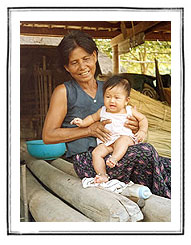
story # 4: Phorn Hun, Cambodia
A Sturdy Roof Overhead
Phorn Hun never had property of
her own. She lived in a thatched-roof house along
the fence of a pagoda. No one, not even private moneylenders,
dared to give her a loan. In 1998, however, Mrs.
Hun approached ACLEDA Bank and explained her unfortunate
situation. She told them about her idea to start
a noodle business and they offered her a loan of
US$ 25. Only a few years later, Mrs. Hun’s
profit’s enabled her to buy a small piece of
land to build a wooden house with a metal sheet roof,
a luxury she could never afford before. She is still
an active borrower of ACLEDA Bank; she has since
had ten subsequent loans. ACLEDA Bank gave Mrs. Hun
a chance at a new and successful enterprise—and
she capitalized. |
| |
|
| |
back to
top |
|
 |
Aishwarya Rai, actress and Year of Microcredit spokesperson
"Throughout my travels, I have learned that we can
do much more to help women and children who are economically vulnerable.
By giving low-income women access to credit and savings, they can
increase their incomes, build assets and better the lives of their
families. They are able to spend their money on what is important
to them: medical care, better food and education for their children.
In my home country of India, I have seen the beauty in empowering
women. It is up to us to give them a chance and along with the United
Nations and microfinance we are doing just that." |
 |
|