|
Donate
to the Year of Microcredit!

United Nations Capital Development Fund
in collaboration with
Financial Women's Association
Women Advancing Microfinance
Women's Association of Venture and Equity
85 Broads
and
Women's Bond Club of New York
is pleased to invite you to a breakfast panel
in celebration of the
International Year of Microcredit
2005
Friday, June 10, 2005
7:45 until 10:00 in the morning
Delegates Dining Room, 4th Floor, United Nations
Headquarters
Visitors' Entrance at 46th Street and First Avenue
$100 per ticket
(Please bring a printout of your email confirmation
for security purposes)
Panel Discussion will focus on "Wall Street and
Microfinance;
applying sophisticated finance to this emerging
industry"
Special guests and panelists will include:
Ms. Nane Annan, Wife of Secretary-General
Kofi Annan (invited)
Mr. Tom Easton, New York Bureau
Chief, The Economist
Ms. Fatimata Lonfo, Global Microentrepreneur
Award Winner
Mr. Jack Lowe, CEO, BlueOrchard
Finance s.a.
Ms. Maria Otero, CEO, ACCION
International
Mr. David Satterthwaite, CEO,
Prisma MicroFinance, Inc.
Beatriz Armendariz de Aghion,
Lecturer in Economics at Harvard University,
and Jonathan Morduch, Associate
Professor of Public Policy and Economics at New
York University will be signing copies of their
new book, "The Economics of Microfinance."
Proceeds will benefit the Global Mircoentrepreneurship
Awards Program
and the Microentrepreneur Marketplace
Online Registration is available at http://women-wave.org/
Registration closes at 4 pm on June 9
For questions dial: +1-212-906-6308
For security reasons, only confirmed invitees
will have access to the building. Please bring
photo identification with you.
Business Attire or National Dress Recommended
The United Nations wishes to
acknowledge WAVE for its support with the payment
process.
Microcredit summary
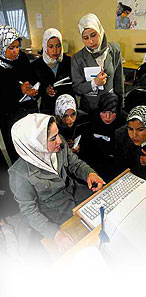
Microcredit has been changing the lives of people
and revitalizing communities since the beginning
of trade. Currently, microentrepreneurs use
loans as small as $100 to grow thriving businesses,
and in turn, provide for their families,
leading to strong and flourishing local communities.
The Year of Microcredit 2005 calls for building
inclusive financials sectors and strengthening
the powerful, but often untapped, entrepreneurial
spirit existing in communities around the
world.
Speaker Biographies:
Fatimata Lonfo, Owner, Windyla's
Boutique and Hairbraiding Salon; Global Microentrepreneur
Award Winner
Fatimata Lonfo fled her native Cote d'Ivoire,
a West African country now mired in civil war,
in October 2001. An airline executive in her
old country, the newly arrived refugee scrubbed
toilets, worked under-the-table retail jobs and
braided hair for nearly a year before taking
a leap of faith and starting her own business.
"My friends said, 'You crazy,'" she
said as she perched over a young girl's half-braided
head of hair in the back room of her colorful,
unheated African clothing store. " 'You
know here is not like Africa. You cannot open
a business if you don't have documents, who is
going to give you the things to open?' And I
said, me, you don't know me. When I want to do
something, I will do it."
Now the proud owner of Windyla's
Boutique and Hair Braiding Salon in Staten Island,
Ms. Lonfo credits her success to God, to perseverance,
and to ACCION New York, the non-profit microfinance
organization that gave her first small business
loan after many banks had refused. A creative
risk-taker with a flair for unique designs, Ms.
Lonfo gets the word out about her business by
putting on fashion shows to showcase her new
lines. Her business supports her and her three
children, the oldest of whom started studying
immigration law in community college this fall.
Asked for her reaction to winning
the grand prize at the Global Microentrepreneurship
Awards in October 2004, Ms. Lonfo replied with
a smile, "That makes me feel like an important
person now. An important person in America."
Jack Lowe is the Chief Executive
Officer of BlueOrchard.
BlueOrchard Finance s.a. is a microfinance investment
consultancy. Our mission is to promote private
investments in projects and enterprises contributing
to the sustainable development of micro-entrepreneurship
in emerging economies. Our action is grounded
in the philosophy that development must be beneficial
to all its stakeholders in order to be sustainable.
We firmly believe that social and
financial returns can be simultaneously obtained
through microfinance investments and that this
makes microfinance both a powerful tool for economic
development and a very attractive new asset class
worth considering in a diversified investment
portfolio strategy.
BlueOrchard is the adviser of the
Dexia Micro-Credit Fund, which is the first private
worldwide and fully commercial microfinance investment
fund. It currently services about fourty microfinance
institutions in twenty different emerging economies.
BlueOrchard also advises the responsAbility Global
Microfinance Fund since December 2003.
BlueOrchard has also issued two tranches
of CDO's in the US to support long-term loans
to larger MFI's. Its total assets under management
are roughly 150 million dollars.
Jack Lowe's long entrepreneurial
career took him to eight different countries
and into a range of businesses. His career began
in the Far East, where he opened with Japanese
colleagues the McKinsey & Co. office in Tokyo.
After coming to Switzerland in 1974, he started
several franchising businesses, and in 1986,
upon the sale of these businesses, became a partner
of Montgomery Securities and crafted their international
business activities, including venture and private
equity funds outside the U.S. Upon the sale of
Montgomery to Bank of America in 1997, he acquired
several medium-sized businesses he now controls,
some of which are outside Europe in emerging
markets.
Jack Lowe holds an MBA in Finance
from Stanford University
María Otero, President & CEO
of ACCION International
María Otero is president & CEO of
ACCION International. ACCION is a leading global
microfinance institution that seeks to open the
financial systems in developing countries to
reach the poor. ACCION provides technical assistance,
equity investment and financial services to 27
of the most advanced microfinance institutions
in the world, which ACCION helped start and/or
grow. Most of these microfinance institutions
are regulated, are members of the ACCION Network,
and together reach 1.5 million borrowers with
a portfolio of over $860 million. Ms. Otero first
joined ACCION in 1986 as director of its lending
program in Honduras, where she lived for three
years. She became president of the organization
in 2000.
Ms. Otero is a leading voice on sustainable
microfinance, and has published extensively on
the subject, including as co-editor of The
New World of Microfinance, published by
Kumarian Press. Ms. Otero chairs the board of
ACCION Investments, a US$20 million investment
company for microfinance. She also serves on
the boards of directors of three regulated microfinance
institutions in Latin America: Mibanco /Peru,
BancoSol/Bolivia and Compartamos/Mexico, and
one in Africa. Ms. Otero also serves as the chair
of the MicroFinance Network, a global association
of 30 leading microfinance institutions, and
is coordinator of the Council of Microfinance
Equity Funds, which convenes 18 equity investment
funds dedicated to microfinance. Ms. Otero serves
on several other boards, including that of the
Calvert Foundation and the United States Institute
of Peace. She was chair of the board of Bread
for the World from 1992-1997. In 1994, President
Clinton appointed Ms. Otero to serve as chair
of the Board of Directors of the Inter-American
Foundation, a position she held until January
2000. Since 1997, Ms. Otero has been an adjunct
professor at the John Hopkins School for Advanced
International Studies (SAIS). In 2000, she received
Hispanic Magazine's "Latina Excellence Award," and
was also featured in Latina magazine. Maria Otero
has an MA in Literature from the University of
Maryland and an MA in International/Relations
with a focus on economic development from Johns
Hopkins SAIS. She was born and raised in La Paz,
Bolivia, and resides in Washington, DC with her
husband and three children.
Jonathan Morduch
Jonathan Morduch is Associate Professor of Public
Policy and Economics at New York University.
He is also Chair of the United Nations Steering
Committee on Poverty Measurement. Prior to
joining NYU, he taught on the Economics faculty
at Harvard University, was a National Fellow
at the Hoover Institution at Stanford University,
and was a MacArthur Foundation Research Fellow
at Princeton University. In 2002-3 was an
Abe Fellow at the University of Tokyo. His
research on risk, financial markets, and
poverty and inequality has been published
in the Review of Economic Studies, Economic
Journal, Journal of Econometrics, Journal
of Development Economics, and Journal
of Public Economics. A new book on The
Economics of Microfinance (co-authored
with Beatriz Armendariz de Aghion) will be
published by the MIT Press in May 2005. His
current research is on the political economy
of foreign aid and the economic foundations
of social investment. He is also presently
involved in analyses of rural finance in
Indonesia and of the behavior of SafeSave clients
in urban Bangladesh.
Endorsements - The Economics
of Microfinance
"The microfinance movement is
bringing hope, prosperity, and progress to many
of the poorest people in the world. It is necessary
to use critical economic reasoning to understand
why the movement is such a success and how its
exact achievements can be assessed and scrutinized.
This book is a splendid contribution to that
goal, and will be a great help to students, teachers,
and practitioners in economics and the social
sciences."
--Amartya Sen, Lamont University Professor, Harvard
University, Nobel Laureate in Economics (1998)
"A great place to learn how
and why microfinance really works, and where
it hits its limits. The book, written by two
leading young economists, brims with new evidence
and provides fresh perspectives on old debates.
Clearly written and sharply argued, it revisits
and transforms important ideas about poverty
reduction, finance, and incentives. The authors
describe what we know and what we need to know
in order to move forward."
--Joseph E. Stiglitz, Professor of Economics
and Finance, Columbia University, Nobel Laureate
in Economics (2001)
"Microfinance is playing a key
role in the economies of many developing countries,
providing small-scale entrepreneurs with the
access to financing that is so often unavailable
from commercial and state banks. This book provides
an accessible, analytical roadmap for understanding
this important trend. The authors tackle central
debates and provide new evidence, giving readers
tools to create future innovations."
--George Soros, Founder and Chairman, Open Society
Institute
"The promotion of microfinance
is one of the most significant innovations in
development policy of the past twenty-five years.
This timely book provides a guide to its main
ideas and reviews the evidence in a way that
is both accessible and rigorous. It will be a
valuable resource for students, researchers,
and practitioners."
--Timothy Besley, Professor of Economics and
Political Science, London School of Economics
and Political Science
"This is an important book by
two of the leading economists in microfinance,
detailing what we know and don't know about the
subject. It is an accessible book laden with
examples, but it doesn't sacrifice intellectual
rigor. It should be of great interest to students,
researchers, and practitioners with an analytical
bent."
--Raghuram G. Rajan, University of Chicago and
the International Monetary Fund
David Satterthwaite, MicroCapital
'MicroCapital' is commercial investment in microfinance,
advocating for it to become a certified asset
class. Currently, microfinance is a long
way from an asset class: the investment landscape
is dominated by governmental and charitable
aid funding. The mission of MicroCapital
is to provide business people with candid,
bottom-line information on microfinance investment.
David Satterthwaite leads MicroCapital.
He has been recognized with awards from Fast
Company, Hewlett Packard, the National Social
Venture Competition, and the Puget Sound
Business Journal as well as mentioned in Financial
Times, Reuters, and The Wall Street
Journal.
David is President & CEO of Prisma
MicroFinance, Inc. Prisma is a for-profit retail
micro-lender that makes micro-loans in Honduras
and Nicaragua since 2001. Prisma is a U.S. Holding
Company operating wholly owned subsidiaries in
Central America. From 1995-2000 David lived in
Nicaragua where he founded a credit union, which
was the predecessor to Prisma.
David has sat on the boards of several "for-profit
social enterprises" including Access
Technology Learning Center, a technology
and training company increasing workplace productivity
of the blind, First Immigrants Funding,
a mortgage company focused on immigrant borrowers, Fonkoze,
a Haitian micro-lender, and Bridges to Business,
a training and job placement agency for at-risk
youth. Additionally, he consults both for-profit
and non-profit firms on corporate strategy and
fund-raising.
David graduated with honors from
Haverford College with degrees in philosophy
and feminism. He periodically teaches a class
on "globalization" at Boston College
where he is pursuing his decorate thesis entitled "Private
Property for All".
|