|
||||||||
|
|
Be sure to visit our Microfinance Matters page where you can sign up for and view the Microfinance Matters newsletter.
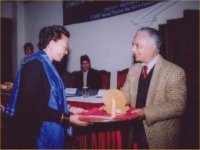
UNDP, UNCDF and local NGO partners recognized the achievements of two successful Nepali women entrepreneurs during the launch of the International Year of Microcredit 2005 in Kathmandu. Bhim Kumari Subba and Phuleshwori Devi Chaudhari were chosen by their respective cooperatives as most successful entrepreneurs. "If we are thinking in terms of democratic, equitable and sustainable development, then we must ensure that people at large are part of development, which can be achieved through poverty alleviation. Microcredit is an integral part of the whole poverty alleviation phenomenon in developing countries," said Dr. Mohan Man Sainju, Vice Chairperson of Poverty Alleviation Fund (PAF). Alessandra Tisot, UNDP Deputy Resident Representative, remarked that a majority of micro credit clients are women, who tend to be more successful than men in investing the money. "UNDP is very active in promoting gender equity at all levels of society, and microcredit is clearly a way to operationalize gender equity policies and to empower women in practice," she said. "We should use the International Year of Microcredit to build awareness on the importance of fostering inclusive and sustainable microfinance institutions that help people improve their own lives." Bhim Kumari Subba
She has been turning a reasonably good profit from her project, paying her loan amount in time, providing active leadership to the group members. Her project has provided jobs for 20 other women, including survivors of sex trafficking. She also provides training to destitute women. Phuleshwori Devi Chaudhari
Fortunately, the year before Phuleshwori Devi had joined a cooperative promoted by the Swabhalamban Bikas Bank. She took an initial loan of Rs.2,000 ( appox. US$27), which she used to buy rice to sell at the weekly market. She made a profit of Rs.700 (about US$10) and bought a baby goat, which in turn she sold at a profit once it matured. After 7 months, she took a second loan of Rs.5,000 (US$68) and bought other goats. After several rounds of loans and payments, she now has a grocery store with a stock worth Rs.50,000 (US $684). She has also managed to purchase land of her own and has become the family breadwinner.
ROME, Jan 21 (IPS) - Of the wide range of strategies identified
for combating world poverty, the promotion of microcredits
-- and other forms
With the United Nations International Year of Microcredit 2005 just two months old, a blue-ribbon group is holding a major symposium Saturday at UN Headquarters in New York to highlight changes in the use of the small loans to achieve the Millennium Development Goals (MDGs) of halving extreme poverty by 2015. Since its launch on 18 November last year, "the International Year of Microcredit has given us an opportunity to harness enormous momentum and the potential of microfinance, channelling it to an ambitious and innovative work plan that will contribute to the Millennium Development Goals," one of the symposium's keynote speakers, Christina Barrineau of the UN Development Programme (UNDP), said in an interview with the UN News Service today. Before joining the UN Capital Development Fund (UNCDF), Ms. Barrineau - the chief technical adviser for the international year - established a global network for innovation in microfinance, linking major and small banks, along with a Thai Government savings bank and a Kenyan building society. Other keynote speakers at the event presented by the Financial Women's Association (FWA) include investment banker Elizabeth Littlefield, now a Director of the World Bank and the chief executive officer of the Bank's Consultative Group to Assist the Poor (CGAP), which builds microfinance systems for the destitute. The Group's 28 development agency members mandate it to develop and set industry guidelines, provide technical, strategic and policy advice, develop technical manuals and services and deliver training and research, according to the World Bank. The symposium will look at microcredit, microsavings and microinsurance, as well as the role of remittances from abroad. It will answer questions about the barriers to the expansion of microcredit, the role of private capital, whether there is too much microcapital or too little, and how microfinance can reach many more poor people in the next five years. "Microfinance is a win-win situation," Ms. Barrineau said. "Financial institutions and the private sector have profitable new markets, governments have stable financial sectors and poor people can seize opportunities." FWA President Kelly Mathieson noted that microfinance started in the philanthropic community and is now capturing real interest in mainstream capital markets. "With the help of the United Nations, we have brought together top experts from banks, private equity funds, microfinance networks and private donor organizations to explain microfinance and how individuals can participate." Meanwhile, the UN Department of Economic and Social Affairs (DESA) is planning several events to mark the microcredit year, including an expert group meeting and a youth roundtable on "Microcredit/Microfinance and poverty reduction" in June. DESA also will highlight the role of cooperatives in promoting microcredit for poverty reduction on the International Day of Cooperatives on 2 July and will observe the contributions of microcredit on the International Day for the Eradication of Poverty on 17 October.
One of the fondest memories Anggun Cipta Sasmi has of her late grandmother and hometown Yogyakarta is of women sitting on the floor, drawing batik patterns and carefully painting them with brownish wax. "The scent of wax ... it always brings back images of eyang (Javanese for grandma) and the other old ladies and their hands moving graciously," said Anggun, no longer the small-town girl but international diva -- living in Paris and traveling the globe to sell millions of copies of her albums. Eyang was the first woman microentrepreneur known to Anggun, the local star who moved to France in the mid-1990s and shot to global stardom with her hit Snow on Sahara seven years ago. The 30-year-old singer did not follow her grandmother's footsteps by empowering women through home industry. Nevertheless, eyang would have been proud to learn that her granddaughter is now a spokesperson for the United Nations International Year of Microcredit 2005. Standing side by side with other internationally renowned artists -- Golden-Globe nominee Natalie Portman, West African tribal and pop rhythm star Angelique Kidjo, Senegal singer Baaba Maal and Algerian musician Souad Maasi -- Anggun is representing Indonesia, a country praised for its microfinancing success. "Microcredit is important because it helps women to play a greater role in supporting their families' finances, as my grandma did," said Anggun on a recent visit here in her capacity as a spokesperson. "It provides knowledge, motivation and, most of all, an opportunity for poor people to break away from poverty." Alleviating poverty is indeed the main goal of the International Year of Microcredit 2005, which was launched in November last year at the UN headquarters in New York. Microenterprises make up the biggest part of business communities in developing countries, such as Indonesia and Bangladesh, which both see a discouraging number of people living on less than US$1 per day. Such enterprises -- proven strong as they survived the monetary crisis in 1998 -- are seen as the answer to providing jobs and better income for most people. However, many small businesses find it difficult to grow as they do not have the capital to expand. Borrowing from banks, with their strict prudential procedures that require collateral for loans, is not a viable option. A pop singer may seem to some an unlikely candidate to be talking about microcredit. So far-fetched in fact, that the UN did not manage to contact Anggun through their widespread network but through her fan website. "There were numerous messages in the web forum, basically saying that they were looking for me for a UN mission," said the down-to-earth diva, speaking in slightly odd-sounding Indonesian due to her time abroad. "I feel so honored, but also afraid that I cannot fulfill their expectations." However, with number-one hits and blossoming popularity, Anggun's presence in Indonesia had the desired effect: extensive media coverage, particularly from infotainment and television programs targeting housewives. "My role is to talk as best as I can about microcredit. It's minuscule compared to those who work in the field," said Anggun humbly. It will be the role of Indonesia's national committee for microcredit to come up with an initiative for the disbursement of microcredit with less paperwork and simpler requirements -- basically little or no collateral -- and wider access for microentrepreneurs when they seek assistance. The singer, who went from regular teenager to international fame with her album Tua Tua Keladi (The Older The Better) at the tender age of 16, however, made use of the publicity to the fullest. She studiously slipped in a message about microcredit and its importance amid the more commercially selling questions, like her marriage with her French manager, whether she was planning on having babies, and her upcoming new album in February. "What I like about microcredit is the approach, that this is not charity," said Anggun in one of her many interviews that she always faces with a smile on her face. "It's an ongoing effort. It's providing the fishing rod instead of the fish," she said. To prepare for her new role, Anggun studied the materials provided by the UN and the national committee. "It feels like taking a test," she said, followed with a hearty laugh. She also asked about a lot of things, particularly how businesses work, when she made a short visit to an entrepreneur in Sumedang, West Java, during her three-day stay in Indonesia. Nevertheless, Anggun readily admits that she is not an expert, nor does she pretend to know all the figures, numbers or strategies. "As I said, I'm no economist," she said. "I'm just a post(wo)man, delivering the message, that microcredit is there, and that it works." www.thejakartapost.com/detailfeatures.asp?fileid=20050118.S02&irec=1
"Nowadays, the Western press rarely mentions that certified growth miracle, that leviathan of global trade, China, without adding and India. In an admittedly unscientific test, a Google search reveals over 10 times more references linking India and China than India and tiger, and 100 times more than India and maharaja," Rajan said. And considering that UN has dedicated 2005 as the international year for microcredit, in an effort to build support for making financial services more accessible to poor and low-income people, India is likely to remain top of the mind for Rajan who is the first Indian to hold the coveted post of chief economist at the IMF. Author of the book Saving Capitalism from the Capitalists, he now joins an impressive list of who's who from the financial world who have formed the advisor's group to the UN's International Year of Microcredit. Chaired by Citigroup's vice chair Stanley Fischer, the group consists of top financiers and bankers. So what does microcredit actually mean to the poor individuals or households? "It can mean a range of things -- it can make an enormous difference in the lives of poor people and substantial wealth generation. It may mean working capital for someone to run a dhaba-- which in turn severs the link to an exploitative local moneylender-- to having productive assets during a family illness. It also means self-respect and many NGOs working in India often point out this element of self-respect especially for women since a bulk of micro-credit initiatives focus on women. When women generate wealth, this changes the power equation in many small households," says Rajan, who prior to the IMF job, taught at the Graduate School of Business at the University of Chicago where he is the Joseph L. Gidwitz professor of finance. His research is broadly on the role of institutions, especially financial institutions, in fostering economic development. In 2003, he was awarded the inaugural Fischer Black Prize by the American Finance Association for contributions to finance by an economist under 40. An alumni in electrical engineering from IIT-Delhi and MBA from IIM-Ahmedabad, Rajan got his Ph.D. from MIT and was a visiting faculty member at the Indian School of Business, Hyderabad. Also an advisor to Sebi, he feels that when large state-owned banks undertake micro-credit it could breed corruption and lack of efficiency. "It is also hard for central banks to do credit assessment especially for people with limited collateral. Just like credit assessment is difficult, so is ensuring repayment. Where there is promise is the self-help and mutual-help groups, which are part of NGO programmes. Also with India already having a burgeoning technology culture, it would be good to have technology to support this work. If we can have individual ID numbers like extending the PAN number and if there is a way to track credit history through technology, it will be a good starting point. Using technology can also reduce the cost of credit evaluation and credit delivery," feels Rajan. He also feels that it's time for private banks to get into microcredit. "The year of microcredit is a way of focusing attention on microcredit and microfinance and to assess what initiatives are required. Once we understand what actually works and what doesn't, the real processes can be understood. With more private banks getting involved and not just NGOs, it is very encouraging. Commercial banks obviously see that there is a profit to be made. Reputable banks like ICICI, Citibank, ING Group are getting involved -- banks that are typically going into this with business motives and because they see that there is a profit to be made. This combination of the financial strength of large banks with the lending acumen of NGOs is a very positive development. With more private involvement, many of the impediments to microfinance will be better understood and this can lead to necessary regulatory steps being taken," he adds.
Barbara Crossette does not always favor microcredit. But as widows and low-wage workers in countries like Sri Lanka struggle with the devastation of the tsunami, she says now--if ever--is the time for lots of small aid packages. Editor's Note: The following is a commentary.
The opinions expressed are those of the author and not
necessarily the views of Women's eNews. The programs--in which lenders extend small loans to individuals or very small enterprises--are often too small to make any long-term difference and impose interest rates around 20 percent--too high to allow for much real capital formation. While micro credit has been a phenomenal success by some terms--the number of borrowers topped 55 million by 2004 and the United Nations is making this the Year of Micro credit--critics also pointed out that it is no panacea. Low income, they say, is only part of the poverty trap. Poor health, lack of sanitation, bad schools or no schools at all and a low status of women in society are burdens that limit the ability of loans to actually improve life. The U.N.'s Development Program measures these drawbacks in an annual report. Rounaq Jahan, a Bangladeshi feminist and author, has argued that there is scant evidence that microcredit alone empowers women. But if ever the time and place were right for the quick introduction of a huge infusion of microcredit loans, it is now, in the stricken coastal regions of South and Southeast Asia. While government leaders talk about debt relief for nations that may or may not transfer those savings to local people most affected, a strong chorus of economists has been saying, "Hold on. The financial effects of this tsunami disaster are not going to be felt mostly at the national level." Small Entrepreneurs Flattened Women. That's the other part of this equation. Among all the famous voices and faces heard and seen on television screens in the last few weeks, only James Wolfensohn, president of the World Bank, has articulated the importance of women to rehabilitation and relief. Wolfensohn was speaking at an impromptu news conference while touring Sri Lanka, where many fishermen died and left behind women who may never have had to work for pay and children whose needs will have to be met. Sri Lankan women are, on the whole, well educated--the country has one of the region's highest female literacy rates. As a result, they--along with Thai women--are in a good position to learn new skills to compensate for losses. So let's get going: This is the best place to start. Wolfensohn, who says that he is planning to step down as World Bank president in June, has been one of the strongest promoters of women in the larger United Nations system. The World Bank has been focusing for several years on the crucial role of women in development, while the United Nations itself has weaseled out of its commitment to women on several fronts. U.N. Leaders Buckle on Women's Rights Without giving women these tools to take charge of their lives, neither poverty nor HIV/AIDS can be mitigated. That's because women are critically important to families and families are the building blocks of communities. The devastated areas of Asia would prove the point, if the world would stop looking only at the big macroeconomic picture and begin focusing on a million individual economic and financial needs. Yes, the high cost of microcredit interest rates can be crippling over the long term. And yes, the claims of microcredit have also been questioned by anecdotal evidence that a lot of the loan money was collected by women and then given to men. In the wake of this disaster, that problem should be forgotten and the short-term needs of people should be the top priority. In the fishing communities of Asia, many hardworking men who survived have no assets other than a ruined boat, or no boat at all. In television interviews they say that they can live with interest rates of 20 percent or higher, just to get back to sea. They know that this is a one-time expense that is essential to future economic independence, and they deserve to be heard, too. Put it to the test. Barbara Crossette was chief correspondent for The New York Times in Southeast Asia and South Asia and later the paper's U.N. bureau chief.
The International Year of Microcredit 2005, the United Nations' first worldwide campaign to promote microcredit was successfully launched in New York on November 18, 2004. To launch this global campaign in China, Her Royal Highness Princess Mathilde of Belgium, member of the UN emissaries group of the Year, visited microfinance projects in Tongzhou District, Beijing on November 22, 2004 during her official visit to China. The International Year of Microcredit 2005 "offers a pivotal opportunity for the international community to engage in the shared commitment" to "build inclusive financial sectors that help people improve their lives," said Kofi Annan, Secretary-General of the UN in New York when launching the Year. "The United Nations is counting on the International Year of Microcredit 2005 to help galvanize implementation of the Millennium Development Goals to halve the population of the world living in extreme poverty by 2015," said Khalid Malik, the United Nations Resident Coordinator and the United Nations Development Program (UNDP) Resident Reprehensive, when he accompanied Princess Mathilde for the visit to the microfinance projects in the Chinese capital. In Tongzhou, Yang Hailing, a 44-year-old women and group leader of a microfinance workshop, shared her experience with the Princess on how she has been using microfinance loans to set up a fabric workshop to train more than 2,000 rural women to make hand-made knitting products. "Microfinance is a new economic means that effectively increases reemployment opportunities for vulnerable rural women like me and helps us to have a better life," said Yang. Congratulating Yang and other women for their work, the Princess said: "The Year of Microcredit will highlight how women's talent and innovation, together with access to credit and savings can give them the power to make long term investments in their families, communities and their children's lives." According to Zhang Xiaoyan, the Chairperson of Tongzhou District Women's Federation, this microfinance project was created based on the experience from a previous project supported by UNDP, the Australian Aid for International Development and the All China Women's Federation in Tianjin. It has introduced innovative interventions of microcredit fund and support to establish women's business incubation centers for job creation and reemployment of laid-off women workers. UNDP is one of the international agencies who first introduced microfinance into China in early 1990s and piloted its microcredit program in 17 provinces and two municipalities with a revolving fund of US$10 million. Since then, over 60,000 poor clients have benefited from these projects. UNDP is currently supporting the People's Bank of China to review its legal framework and assist the central bank to develop policy and regulations on microfinance development in China. Other UN agencies, such as UNICEF, WFP/IFAD and UNHCR have also used microcredit as a conduit for income generating activities and poverty reduction. The campaign for the International Year of Microfinance in China provides a platform for convening all key stakeholders to strengthen the financial sector and make it more inclusive. The current reform of its regulatory and supervisory oversight mechanisms will enable it to benefit a larger number of the Chinese population. |
|
|||||||||
|
|||||||||||



 After
completing 10th grade, Bhim Kumari came to Kathmandu and
learned typing in the hope of finding a job. Unable to find
work, she joined the Women's Co-operative Society Ltd in
1999. With a loan from her co-operative, she started a group
handloom project along with other four members. Presently,
her project produces handloom products worth Rs.1,500,000
per year (US$20,547) with a net profit of Rs.200,000 (US$2,739).
After
completing 10th grade, Bhim Kumari came to Kathmandu and
learned typing in the hope of finding a job. Unable to find
work, she joined the Women's Co-operative Society Ltd in
1999. With a loan from her co-operative, she started a group
handloom project along with other four members. Presently,
her project produces handloom products worth Rs.1,500,000
per year (US$20,547) with a net profit of Rs.200,000 (US$2,739). 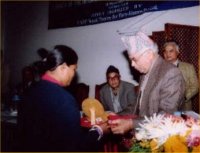 In
1994, Phuleshwori Devi's land was washed away by flood, leaving
her family of six with food production capacity of only a
few months.
In
1994, Phuleshwori Devi's land was washed away by flood, leaving
her family of six with food production capacity of only a
few months.  (WOMENSENEWS)--Microcredit
programs, especially for women, have been justifiably criticized
in the past for falling short of real development aid.
(WOMENSENEWS)--Microcredit
programs, especially for women, have been justifiably criticized
in the past for falling short of real development aid.